
W3C Web of Things
The Web of Things (WoT) counters IoT fragmentation by extending proven Web standards. Through standardized metadata and reusable building blocks, W3C WoT enables seamless integration across IoT platforms and application domains.
Web of Things in a Nutshell
In typical IoT projects, developers face a fragmented landscape of proprietary systems, incompatible communication protocols, differing data models, and varying security requirements. Applications built this way demand high effort for narrow use cases and become difficult to extend, maintain, or reuse over time.
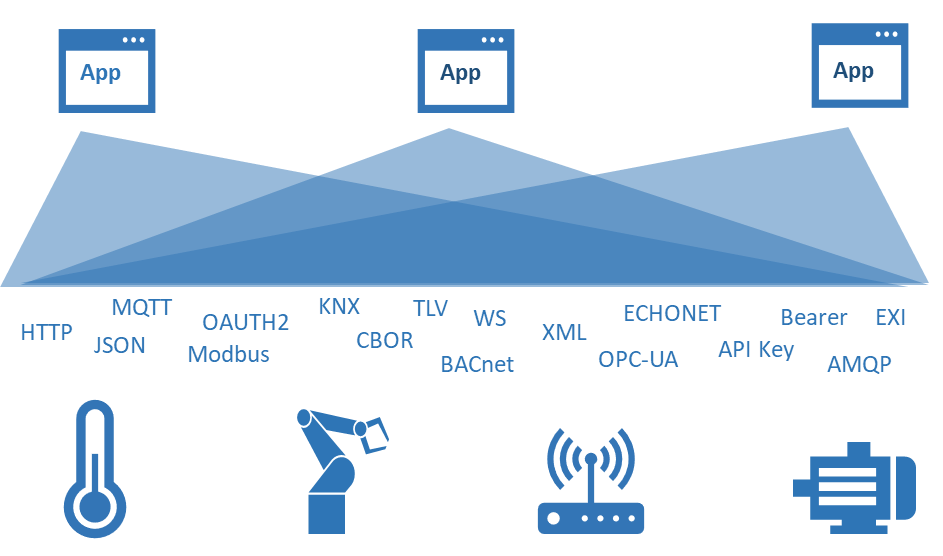
WoT provides standardized building blocks that simplify IoT application development by applying the well-established Web paradigm. This approach boosts flexibility and interoperability—especially for cross-domain scenarios—while enabling reuse of proven standards and tooling. WoT unlocks the commercial potential held back by IoT fragmentation.
Read the WoT Architecture specification →
WoT Interactions
WoT introduces a simple, universal interaction model based on Properties, Actions, and Events. Any IoT network interface can be described using this abstraction, giving applications a common way to discover an IoT service's metadata and understand how to access its data and functions—regardless of the underlying technology.
Learn about the interaction model →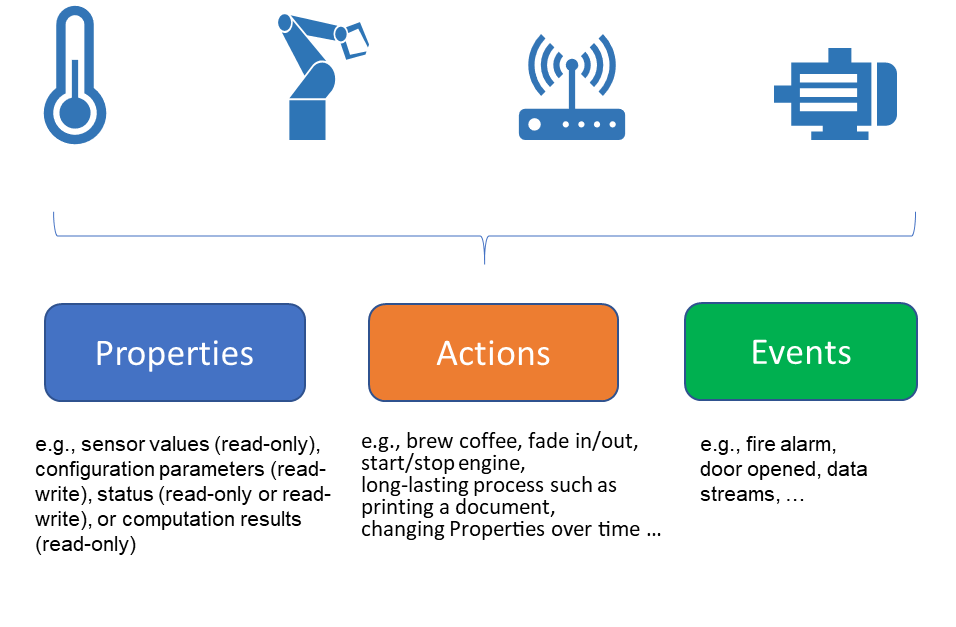
WoT Building Blocks
The WoT Thing Description (TD) is the central building block of the Web of Things. Much like an
index.html serves as a website's entry point, a TD documents everything needed to interact with an
IoT device: available data and functions, communication protocols, payload encoding, and security mechanisms.
Expressed in JSON-LD, TDs can be served directly by devices or hosted in a TD Directory.
WoT is protocol-agnostic. WoT Binding Templates define how specific protocols—such as MQTT, HTTP, CoAP, or Modbus—map onto the Properties–Actions–Events abstraction. Each binding template provides a guideline for clients to activate WoT interactions through the corresponding network interface.
Read the Binding Templates specification →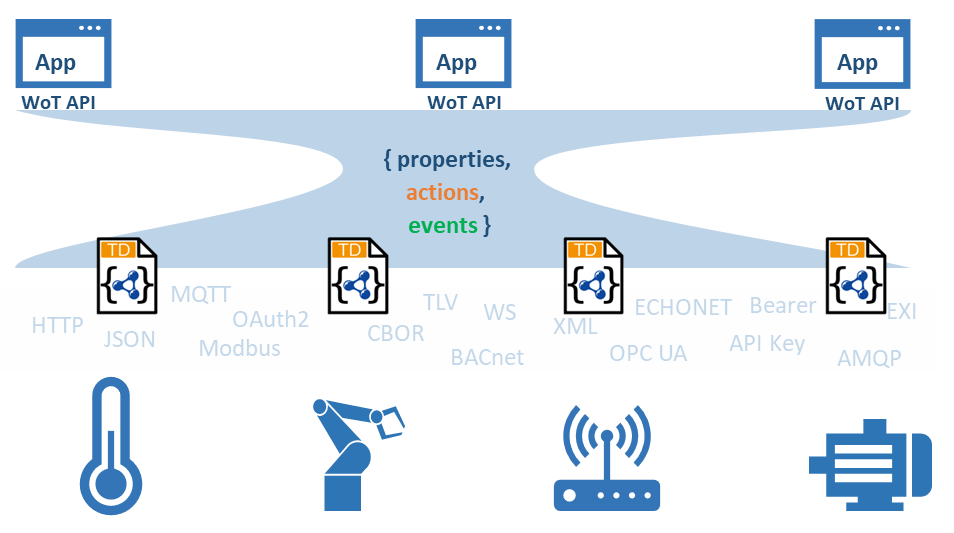
The WoT Scripting API defines an ECMAScript (JavaScript) API that mirrors the Thing Description specification and supports the WoT interaction model. It provides the interface between behavior implementations and a scripting-based WoT runtime. While the API is defined for JavaScript, equivalent APIs can be derived for Java, C/C++, or other languages.
Read the Scripting API specification →WoT Security and Privacy guidelines help ensure the secure implementation and configuration of Things. Security and privacy considerations are essential for any system implementing W3C WoT.
Read the Security and Privacy guidelines →